The car rental market has fundamentally changed over the last decade. What used to be a relatively uniform business built around daily rentals and standardized vehicle classes has evolved into a highly segmented mobility ecosystem. Customers no longer rent cars for the same reasons, with the same expectations, or under the same economic logic. As a result, growth strategies that relied on a single brand and a one-size-fits-all offering are increasingly reaching their limits.
In response, more operators are building multi-brand rental groups: structured portfolios of specialized brands, each designed to serve a clearly defined niche, while operating on top of one centralized operational system. This shift is not driven by marketing trends, but by hard operational and financial realities. Multi-branding has become a way to scale without sacrificing clarity, margins, or control.
Why Multi-Brand Strategies Are Growing in the Car Rental Industry
Market Fragmentation and Niche Demand
The primary force behind multi-brand expansion is demand fragmentation. Rental customers now behave very differently depending on context, and these differences affect pricing sensitivity, booking behavior, service expectations, and lifetime value.
Economy rentals
Economy-focused customers prioritize price and availability above all else. They compare aggressively across channels, switch brands easily, and tend to book late. Margins are thin, but utilization can be very high if fleet turnover is optimized. Attempting to upsell experience or premium service in this segment usually produces little return.
Premium and luxury rentals
Premium customers operate under a completely different decision logic. They value brand perception, consistency, vehicle condition, and service quality. Price is important, but it is not the primary differentiator. When premium offerings are mixed into generic brands, they often underperform because the brand signal is too weak to justify higher rates.
EV-focused eco customers
Electric vehicles attract a distinct audience with specific expectations. These customers care about charging access, range transparency, digital tools, and sustainability positioning. Treating EVs as interchangeable with ICE vehicles inside a traditional brand often leads to low utilization and customer dissatisfaction.
Corporate & long-term clients
Corporate customers behave more like B2B partners than retail renters. They expect contracts, predictable pricing, consolidated invoicing, reporting, and service reliability. Mixing corporate logic with daily retail rentals under one brand frequently creates internal conflicts over fleet priority and pricing rules.
Tourists vs locals
Tourists typically book earlier, rely on OTAs, and value simplicity and insurance clarity. Local customers book later, are more price-sensitive, and often use rentals as temporary replacements. Serving both segments under one undifferentiated brand weakens positioning for each.
Younger demographics and micro-mobility
Younger customers increasingly engage with short-term, flexible mobility such as e-bikes, scooters, and subscriptions. Their expectations around digital access and usage flexibility differ significantly from those of traditional rental users.
Advantages of Multi-Brand Expansion
Multi-brand strategies allow operators to address these incompatible behaviors without compromise. Each brand can be optimized around one dominant demand pattern, while shared ownership enables centralized fleet control, analytics, and cost efficiency. Instead of diluting one brand to serve everyone, operators gain clearer positioning, stronger pricing power, and greater resilience across market cycles.
When a Rental Business Should Consider Multi-Branding
Deciding to introduce multiple brands is less about ambition and more about recognizing structural limits within a single-brand model. In practice, most rental companies that succeed with multi-brand expansion do so because their existing business has reached a point where different types of demand can no longer be served efficiently under one identity, one pricing logic, and one operational narrative.
Signals and Readiness Criteria
Demand exceeding niche boundaries
One of the clearest signals is recurring demand that does not naturally fit the core brand. This often appears gradually: customers ask for long-term contracts, subscription-style pricing, premium vehicles, EVs, or specialized use cases that feel like exceptions at first. Over time, these “exceptions” become frequent enough that forcing them into the core brand starts to distort pricing, service standards, and customer expectations. When demand consistently pushes beyond the original niche, it usually indicates that the market is ready for segmentation.
Operational scalability
Multi-brand operations multiply complexity. Fleet planning, pricing rules, reporting, and staffing all become more layered. If the current business struggles with basic scalability — for example, inconsistent utilization across locations or unclear accountability — adding brands will magnify these issues. Conversely, operators with standardized workflows and clear performance visibility are far better positioned to support brand-level differentiation without losing control.
Infrastructure readiness (software, staffing, locations)
Technology and organizational infrastructure are decisive. Managing multiple brands without centralized systems capable of separating brand logic while maintaining a unified operational view almost always leads to chaos. Fleet conflicts, inconsistent pricing, and unreliable reporting are common outcomes. Staffing depth and location capacity also matter: brands cannot scale if knowledge and responsibility are concentrated in too few individuals or sites.
Financial capacity for brand development
Launching a new brand requires investment beyond fleet acquisition. Marketing, identity, customer acquisition, and sometimes dedicated service elements all carry upfront costs. Multi-branding should be funded from a position of stability. When cash flow is already under pressure, additional brands increase risk rather than diversification.
Diagnostic Questions Before Expansion
Is the core brand saturating its market?
Slowing growth does not automatically mean market saturation. The key question is whether demand still exists but is constrained by positioning. If the core brand attracts only one type of customer while adjacent segments remain untapped, segmentation may unlock growth.
Is there a clear niche opportunity?
A new brand should exist to serve a clearly defined customer group with distinct needs. If the proposed brand differs only slightly in price or tone, it risks internal competition rather than expansion.
Can the fleet be shared or must it be separated?
Fleet flexibility often determines economic viability. Some niches tolerate shared assets, while others require strict separation to protect brand perception. Understanding this early prevents costly misalignment later.
When these criteria align, multi-brand expansion becomes a logical evolution rather than an experiment. It allows the business to organize demand more precisely, scale with discipline, and prepare for more complex growth without sacrificing operational clarity.
Defining Brand Architecture for a Multi-Brand Rental Group
Brand architecture is the framework that determines how multiple brands coexist, compete, and complement each other inside one rental group. It defines not only how customers perceive each brand, but also how internal teams make decisions about pricing, fleet allocation, and investment. When brand architecture is poorly defined, multi-brand strategies tend to devolve into internal price wars and operational confusion. When it is clear and disciplined, it becomes a source of scale and strategic clarity.
House of Brands vs Branded House
Pros and cons of each model
In a house-of-brands structure, each brand operates as an independent entity with its own identity, messaging, and positioning. Customers may not be aware that the brands share ownership. This model offers maximum flexibility and strong protection against brand dilution, making it particularly effective when serving sharply different niches such as economy versus luxury or retail versus corporate rentals. The trade-off is higher complexity and cost, as each brand requires its own marketing effort and positioning discipline.
A branded-house model, by contrast, places all offerings under a single master brand with sub-brands or tiers. This approach benefits from shared brand equity and lower marketing overhead, but it limits how far individual segments can diverge. In rental operations, branded-house structures work best when differences between segments are incremental rather than fundamental.
Examples from the rental and mobility industries
Large international rental groups often adopt a house-of-brands strategy to separate price-driven volume brands from premium or lifestyle-focused offerings. In contrast, smaller regional operators sometimes favor branded-house models when expanding into adjacent segments such as medium-term rentals or business packages. The key lesson is that architecture should reflect how different the target customers truly are, not how convenient the structure feels internally.
Positioning Each Brand
Value proposition differentiation
Each brand must answer a simple question with precision: who is this brand for, and why is it better for that customer than the alternatives? This includes clarity around use cases, service depth, and acceptable trade-offs. Without a sharply defined value proposition, brands tend to drift toward the same middle ground.
Avoiding pricing cannibalization
Pricing is where weak positioning is exposed fastest. If two brands compete for the same customer with similar offers, customers will migrate to the cheaper option, eroding margins across the group. Clear pricing logic aligned with brand intent is essential to prevent this behavior.
Creating distinct visual and emotional identities
Visual systems, tone of voice, and customer-facing language reinforce separation. Even when fleets overlap, customers should feel they are engaging with a different experience, not a repackaged version of the same service.
Niche-Based Brand Models
Economy brand
Focused on high utilization, fast turnover, and price transparency, this brand prioritizes efficiency over experience.
Corporate and long-term rental brand
Designed around contracts, predictable pricing, reporting, and reliability, this brand operates closer to a B2B service model.
Luxury and exotic brand
Here, presentation, service consistency, and emotional value justify higher rates and lower utilization.
EV-only, micro-mobility, and adventure brands
These brands serve lifestyle-driven or values-based demand, each requiring its own operational logic and customer narrative.
A well-defined brand architecture does not increase complexity for its own sake. It creates boundaries that make complexity manageable, enabling the rental group to grow without losing strategic focus or operational discipline.
Centralizing Operations While Keeping Brand Independence
One of the defining challenges of a multi-brand rental group is balancing operational efficiency with brand differentiation. Centralization is essential for scale, control, and profitability, yet excessive standardization can quickly erode the very distinctions that make multiple brands valuable. Successful rental groups resolve this tension by centralizing infrastructure and governance while allowing brands to remain independent at the customer-facing level.
What Should Be Centralized
Fleet management and utilization dashboards
Fleet is the most capital-intensive asset in any rental business, which makes centralized control non-negotiable. A unified view of availability, utilization, idle time, and vehicle movement across all brands allows management to allocate assets where they generate the highest return. Without centralized dashboards, fleets tend to be “owned” emotionally by brands rather than managed economically by the group, leading to underutilization and internal conflict.
Maintenance and telematics
Maintenance standards, service intervals, damage tracking, and mileage monitoring must follow one consistent logic across the group. Centralizing maintenance planning reduces downtime, prevents duplicated effort, and ensures that vehicles can move between brands when necessary without operational friction. Telematics data is particularly valuable when analyzed at group level, revealing patterns that are invisible within a single brand.
Finance, invoicing, and compliance
Multi-brand structures increase financial complexity through different pricing models, contract types, and payment flows. Centralized finance ensures consistent accounting rules, accurate profitability analysis, and regulatory compliance. It also enables meaningful comparison between brands, revealing which niches truly drive value and which consume shared resources.
HR, training, and standard operating procedures
While service style may differ by brand, core workflows should not. Centralized HR and training ensure that staff across the group follow the same operational standards, understand escalation paths, and can move between brands when required. This reduces dependency on individuals and supports scalable growth.
IT infrastructure and RMS
Technology is the backbone of centralization. A shared RMS and IT stack provide one source of truth for fleet, pricing, reservations, and reporting, while still allowing brand-level configuration and access control.
What Should Remain Decentralized
Marketing and brand communication
Each brand must control its own messaging, channels, and creative direction. Centralized marketing risks flattening brand identity and confusing customers.
Customer experience and service scripts
Although processes are standardized, how they are communicated should reflect brand positioning. Speed and simplicity define economy brands, while reassurance and personalization define premium ones.
Pricing flexibility within brand strategy
Pricing rules and governance should be centralized, but rate setting must remain aligned with each brand’s value proposition.
Preventing Brand Cannibalization
Rate fences
Minimum rental durations, bundled services, or eligibility criteria help ensure customers self-select into the correct brand.
Segment-based positioning
Clear narratives reduce overlap and price-driven switching between brands.
Fleet allocation rules
Explicit rules determine when vehicles can move between brands and when they must remain dedicated, protecting both utilization and brand integrity.
Centralization, when applied to systems rather than identity, allows multi-brand rental groups to scale efficiently while preserving the distinctiveness that makes each brand commercially viable.
Fleet Allocation and Utilization Optimization Across Brands
Fleet allocation is where multi-brand strategy either proves its value or exposes its weaknesses. Vehicles are shared capital assets, but brands are competing demand engines. Without clear allocation logic, fleets drift toward internal politics, brand favoritism, or short-term decisions that damage long-term return on investment. Effective multi-brand groups treat fleet allocation as a dynamic, data-driven process rather than a static brand entitlement.
Shared vs Dedicated Fleet Models
Benefits of shared fleets
Shared fleet models maximize capital efficiency. Vehicles can be redeployed between brands based on demand, seasonality, and utilization patterns, reducing idle time and smoothing revenue volatility. This approach works particularly well when vehicle classes overlap and brand differentiation is driven more by service and pricing logic than by the vehicle itself. Shared fleets also allow groups to test new niches without committing to fully dedicated assets, lowering expansion risk.
Risks of mixing niches
At the same time, excessive sharing can undermine brand integrity. Luxury or lifestyle-focused brands suffer when vehicles are overexposed to high-turnover economy usage. Differences in customer behavior, mileage intensity, and care standards can accelerate wear and dilute perceived quality. This is why successful groups define explicit rules around which vehicles can be shared, under what conditions, and for how long.
Vehicle Assignment Logic
Based on utilization patterns
Historical utilization data provides the most objective basis for fleet assignment. Vehicles should gravitate toward the brand where they achieve the highest effective utilization at acceptable margin levels. A car that sits idle in a premium brand during weekdays may generate strong returns in a business-focused brand during the same period. Allocation decisions should follow usage patterns, not assumptions.
Based on brand seasonality
Seasonality differs sharply across niches. Tourist-driven brands peak during holidays and summer months, while corporate and subscription-based brands often deliver steadier year-round demand. Fleet allocation must account for these cycles, allowing vehicles to migrate as seasons change instead of remaining locked into underperforming assignments.
Based on ROI per niche
Not all utilization is equally valuable. A vehicle producing fewer rental days at a higher contribution margin may outperform one with constant turnover but weak profitability. Allocation logic should therefore prioritize return on invested capital, not raw rental volume.
Predictive Demand Planning
Using historical data and forecasting
Predictive planning transforms fleet allocation from reactive to proactive. By analyzing historical booking curves, lead times, and cancellation behavior per brand, operators can anticipate demand shifts before they materialize. This enables timely reallocation, pricing adjustments, and acquisition planning.
Identifying underperforming vehicles
Multi-brand visibility also makes underperformance visible. Vehicles that fail to meet utilization or margin thresholds within one brand can be flagged early and reassigned, repositioned, or divested. Without this cross-brand perspective, underperformance is often misattributed to market conditions rather than allocation errors.
In a multi-brand rental group, fleet allocation is not about fairness between brands. It is about continuously aligning assets with the demand patterns that extract the highest sustainable value from them. Groups that master this discipline turn fleet flexibility into a competitive advantage rather than a source of internal friction.
Pricing and Revenue Management for Multi-Brand Groups
Pricing is one of the most sensitive and strategically important areas in a multi-brand rental group. While fleet and operations can be centralized with relatively clear rules, pricing sits directly at the intersection of brand positioning, customer perception, and revenue optimization. Poorly governed pricing is the fastest way to trigger internal cannibalization and margin erosion, even when brands appear distinct on the surface.
Shared Pricing Engine vs Brand-Specific Pricing
When to unify
A shared pricing engine makes sense when brands operate within comparable demand dynamics and share similar cost structures. Centralized pricing logic allows the group to respond coherently to market changes, capacity constraints, and competitive pressure. It also ensures that minimum price floors, discount rules, and margin protections are enforced consistently. In these cases, unification does not mean identical prices, but rather a common decision framework supported by shared data.
When to split
Brand-specific pricing becomes necessary when segments differ meaningfully in elasticity, booking behavior, or value perception. Premium, luxury, EV-only, or corporate brands often require pricing models that would be inappropriate for economy or tourist-focused offerings. Forcing these brands into a unified logic usually leads to underpricing premium demand or overpricing price-sensitive segments. Splitting pricing models allows each brand to optimize revenue within its own economic reality while remaining visible at group level.
Dynamic Pricing Across Niches
Demand-based pricing
Demand signals vary widely across brands. Leisure-driven brands respond strongly to seasonality and booking lead times, while corporate and subscription-based brands value predictability over volatility. Effective dynamic pricing respects these differences. Applying aggressive demand-based fluctuations to corporate clients undermines trust, while static pricing in leisure segments leaves revenue untapped.
Competitive benchmarks
Competitive sets should be defined per brand, not per group. An economy brand competes on different terms than a luxury or EV-focused brand, even if they operate in the same geography. Pricing intelligence must therefore be segmented, or it will distort decision-making.
Price floors and ceilings per brand
Clear boundaries protect positioning. Price floors prevent brands from undercutting each other during low-demand periods, while ceilings ensure premium brands do not drift into unrealistic territory that damages conversion. These limits are strategic tools, not arbitrary constraints.
Preventing Cross-Brand Cannibalization
Rate fences
Rate fences are essential to guide customers into the correct brand. Differences in minimum rental duration, included services, mileage policies, or booking conditions reduce opportunistic switching based purely on price.
Eligibility rules
Corporate, subscription, or long-term offers should be gated by eligibility criteria rather than openly accessible retail pricing. This preserves the integrity of each brand’s customer base.
Channel segmentation
Distribution channels should align with brand intent. Allowing all brands to compete head-to-head on the same channels without differentiation invites price wars inside the group.
In a multi-brand rental group, pricing is not just a revenue lever. It is a governance mechanism that defines how brands coexist. Groups that treat pricing as a centralized discipline with brand-specific execution protect both margins and positioning over the long term.
Organizational Structure for Multi-Brand Management
As rental groups evolve from single-brand operations into multi-brand organizations, structure becomes a strategic asset rather than an administrative detail. Without a clear organizational model, complexity grows faster than revenue, decision-making slows down, and accountability becomes blurred. Well-designed multi-brand groups, by contrast, use structure to clarify ownership, accelerate execution, and prevent internal competition from becoming political.
Governance Models
Central HQ + brand managers
This is the most common and often the most effective model for multi-brand rental groups. A central headquarters owns shared functions such as fleet strategy, finance, technology, and compliance, while each brand is led by a dedicated brand manager with clear responsibility for performance. This structure balances control with autonomy. Strategic decisions are made centrally, but execution and market adaptation remain close to the customer. The brand manager acts as the internal advocate for their niche while operating within group-level rules.
Hybrid regional and brand structure
In larger or geographically distributed groups, governance often becomes more layered. Regional managers oversee operations across locations, while brand managers focus on positioning, pricing strategy, and customer experience. This hybrid model works when regional complexity is high, but it requires strong coordination mechanisms to avoid conflicts between geographic and brand priorities. Without clear escalation paths, decision-making can become slow and fragmented.
Key Roles
Brand director
The brand director owns positioning, pricing logic, and performance targets for a specific brand. This role is accountable for ensuring that the brand delivers on its promise without drifting into overlap with other brands in the group.
Central operations manager
This role ensures consistency and efficiency across all brands. The central operations manager defines workflows, monitors execution quality, and resolves cross-brand operational conflicts, particularly around fleet and staffing.
Fleet director
The fleet director manages acquisition, allocation, lifecycle planning, and divestment across the group. In a multi-brand context, this role is critical to balancing utilization, brand integrity, and return on capital.
Revenue manager
Revenue management becomes more complex in multi-brand environments. The revenue manager oversees pricing governance, demand forecasting, and performance optimization across brands, ensuring that pricing decisions support both brand strategy and group profitability.
Marketing manager per brand
While marketing infrastructure may be shared, execution must remain brand-specific. Dedicated marketing leadership ensures that messaging, channels, and campaigns align with each brand’s target audience.
SOP Standardization
Check-in and check-out
Standardized procedures reduce errors, training time, and customer friction while allowing brand-specific presentation and communication.
Damage workflow
Consistent damage assessment and reporting protect assets and ensure fairness across brands, preventing disputes and operational delays.
Maintenance workflow
Unified maintenance processes ensure predictable downtime, accurate cost tracking, and smooth vehicle transitions between brands.
In a multi-brand rental group, structure is not about hierarchy. It is about clarity. Clear roles, defined governance, and standardized execution allow complexity to scale without undermining control or accountability.
Technology Stack for Multi-Brand Rental Groups
Technology is the invisible infrastructure that determines whether a multi-brand rental group remains controllable as it scales. While branding, fleet, and pricing strategies define how the group competes in the market, the technology stack defines whether those strategies can actually be executed without friction. In multi-brand environments, weak or fragmented systems do not merely slow growth; they actively create internal conflicts, blind spots, and revenue leakage.
Requirements for Multi-Brand RMS
Separate pricing models per brand
A multi-brand RMS must support independent pricing logic for each brand while still operating under a unified governance framework. Brands differ in elasticity, discount tolerance, and acceptable volatility. The system must allow these differences to coexist without forcing manual overrides or parallel spreadsheets that undermine pricing discipline.
Fleet pooling management
Fleet is a shared asset, but brands are distinct demand engines. The RMS must support flexible fleet pooling rules, allowing vehicles to move between brands based on predefined criteria while preserving visibility and accountability. Without this capability, fleet allocation becomes informal and politically driven rather than data-driven.
Shared data warehouse
Centralized data is essential for meaningful comparison and decision-making. A shared data layer enables group-level analysis of utilization, revenue, costs, and ROI while still allowing brand-level performance tracking. This dual visibility is what allows management to identify structural strengths and weaknesses across the portfolio.
Access control per brand and team
As brand count increases, so does the need for granular access rights. Teams should see and manage only what is relevant to their role and brand, while central management retains full visibility. Without proper access control, errors increase and accountability erodes.
Multi-location and multi-brand reporting
Reporting must scale across both dimensions simultaneously. The ability to analyze performance by brand, by location, and across the entire group is not optional in a multi-brand structure. Without it, strategic decisions rely on partial or delayed information.
Integrations and Automation
OTA channels per brand
Different brands require different distribution strategies. An effective technology stack allows each brand to connect to appropriate OTA and direct channels without interfering with others. Centralized management of these connections prevents duplication and pricing conflicts.
Payment gateways per segment
Payment expectations vary by niche. Economy and tourist segments may rely on instant online payments, while corporate clients require invoicing and delayed settlement. Technology must support these differences without fragmenting financial reporting.
CRM segmentation
Customer data becomes significantly more valuable when segmented by brand and behavior. A shared CRM structure with brand-level segmentation enables targeted communication, retention strategies, and cross-brand insights without mixing incompatible audiences.
How TopRentApp Supports Multi-Brand Operations
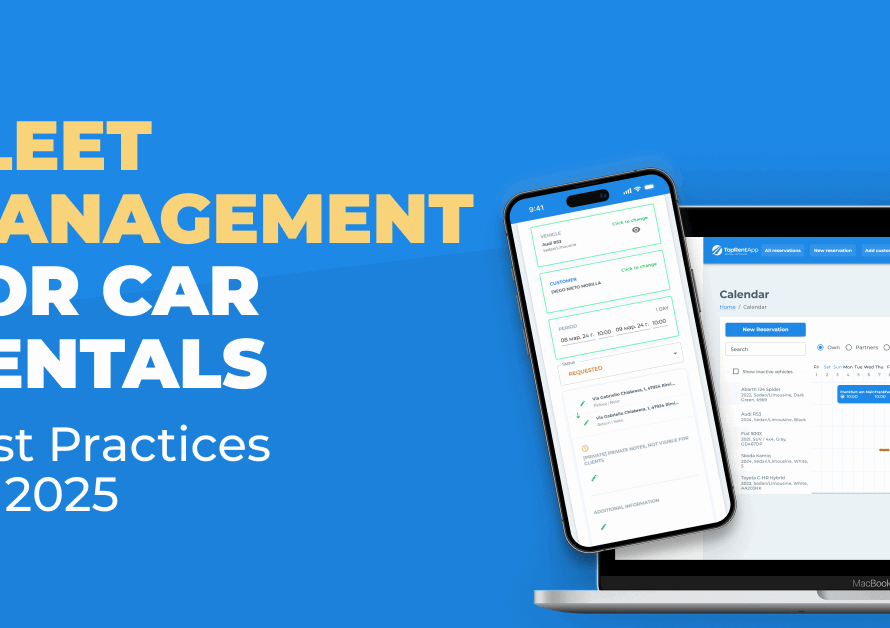
TopRentApp is designed as a centralized rental management system that allows operators to manage growing operational complexity within a single platform. It provides a unified environment for reservations, fleet availability, customer data, contracts, and reporting, giving management clear visibility across the business. Role-based access helps structure responsibilities between teams, while standardized workflows ensure consistent execution across locations and operational units. By centralizing core rental processes in one RMS, TopRentApp helps rental groups maintain control, transparency, and operational discipline as they scale and diversify their business.
Marketing Strategy for Multi-Brand Groups
Marketing in a multi-brand rental group is not about doing more campaigns; it is about designing parallel customer journeys that do not collide with each other. When multiple brands share ownership, the greatest risk is not insufficient visibility, but confused visibility — situations where customers encounter overlapping messages, inconsistent promises, or price comparisons that undermine positioning. Effective multi-brand marketing aligns demand generation with brand intent and operational capacity.
Differentiating Customer Journeys
Booking funnels per niche
Each brand should guide customers through a booking journey that reflects how that segment makes decisions. Economy customers prioritize speed, transparency, and price certainty, while premium and luxury customers expect reassurance, detail, and service cues that justify higher rates. Corporate clients require clarity around contracts, invoicing, and support rather than promotional messaging. Designing separate funnels prevents friction and improves conversion by matching intent instead of forcing uniformity.
Website segmentation
Web presence is often where multi-brand confusion becomes visible first. Separate brand websites or clearly segmented brand sections help maintain narrative clarity and SEO focus. This segmentation allows each brand to rank, convert, and communicate independently, while still benefiting from shared infrastructure and backend systems.
Brand Identity Management
Visual communication
Visual identity is a practical tool, not just a design choice. Color palettes, typography, imagery, and layout conventions signal positioning instantly. In a multi-brand group, these signals must be strong enough to prevent customers from perceiving brands as interchangeable. Consistent visual language reinforces price expectations and service level before any text is read.
Messaging frameworks
Messaging should articulate what each brand stands for and, just as importantly, what it does not try to be. Clear messaging reduces internal overlap by guiding customers toward the brand designed for their needs. When messaging becomes generic, customers default to price comparison, which increases cannibalization.
Cross-Brand Synergies
Shared loyalty programs
Well-designed loyalty structures can connect brands without collapsing their identities. Customers may earn recognition or benefits at group level while engaging with different brands at different life stages. The key is to reward loyalty without encouraging price-driven switching between brands.
Combined remarketing campaigns
Centralized data enables smarter remarketing across the group. A customer who rented an economy vehicle for a short trip may later receive targeted messaging for a premium weekend experience or a long-term offer, based on behavior rather than assumption. This approach increases lifetime value without diluting brand focus.
Referral loops between brands
Internal referrals can replace external competition when brands are positioned correctly. Instead of losing customers who “outgrow” one brand, the group can guide them toward another brand within the portfolio that better fits their evolving needs.
In a multi-brand rental group, marketing is not about maximizing reach for each brand independently. It is about orchestrating demand across the portfolio so that customers encounter the right brand at the right moment, while the group captures value without internal friction or positioning collapse.
Financial Modeling and KPI Framework
Financial discipline is what ultimately determines whether a multi-brand rental group becomes a scalable business or an expensive collection of brands. As complexity increases, intuition and top-line growth metrics lose reliability. Multi-brand structures require a financial model that makes performance transparent at brand level while preserving a clear view of group-wide efficiency.
Key KPIs
Utilization per brand
Utilization must be tracked separately for each brand because acceptable levels differ by niche. An economy brand may require consistently high utilization to compensate for thin margins, while a luxury brand may remain highly profitable with lower utilization due to premium pricing. Aggregated utilization figures hide these realities and lead to incorrect fleet decisions.
RevPAV per niche
Revenue per available vehicle provides a more accurate picture of performance than utilization alone. RevPAV highlights how effectively each brand converts fleet availability into revenue and allows management to compare niches with very different pricing and demand patterns on a normalized basis.
Contribution margin
Contribution margin is essential for understanding which brands actually generate value after variable costs such as maintenance, cleaning, logistics, and customer acquisition. Brands with strong revenue but weak contribution often consume shared resources disproportionately, masking structural inefficiencies.
CAC per brand
Customer acquisition costs vary significantly between niches. Economy and tourist-focused brands often rely on OTAs and paid channels, while corporate and long-term brands depend more on sales-driven acquisition. Measuring CAC at brand level prevents cross-subsidization from distorting investment decisions.
Fleet ROI split by brand
Fleet return on investment must reflect how vehicles perform within each brand context. The same vehicle can generate radically different returns depending on pricing logic, usage intensity, and customer behavior. Brand-level ROI analysis guides both acquisition and divestment strategy.
Overhead Allocation Methods
Per vehicle
Allocating overhead per vehicle provides simplicity and aligns well with fleet-heavy cost structures. However, it can disadvantage brands with lower utilization but higher margins, such as luxury offerings.
Per revenue
Revenue-based allocation ties overhead to earning power but may understate the operational load created by high-turnover, low-margin brands.
Hybrid models
Many mature groups adopt hybrid allocation models that combine fleet size, revenue share, and operational complexity. This approach produces more accurate brand profitability views and supports better strategic decisions.
Profitability Benchmarking Across Brands
Monthly and quarterly reporting
Regular brand-level reporting reveals trends that annual summaries obscure. Monthly and quarterly comparisons make it easier to detect early signs of underperformance or overinvestment.
Seasonality comparison
Seasonality affects brands differently. Comparing seasonal patterns across brands highlights which niches stabilize the group during low-demand periods and which require active rebalancing.
In a multi-brand rental group, financial modeling is not just about reporting results. It is a strategic tool that determines where capital flows, which brands grow, and which must be restructured or exited. Without disciplined KPIs and transparent allocation, multi-brand complexity quickly outpaces control.
Common Mistakes in Multi-Brand Expansion
Multi-brand expansion often fails not because the idea is wrong, but because execution ignores predictable structural risks. Many rental groups repeat the same mistakes, especially during the first stages of brand proliferation, when enthusiasm outpaces operational discipline. Understanding these failure patterns is as important as defining best practices.
Creating brands without a clear niche
One of the most common mistakes is launching additional brands without a sharply defined customer segment. These brands often differ only superficially in name or pricing but do not solve a distinct problem for a specific audience. As a result, internal teams struggle to explain why the brand exists, customers fail to perceive meaningful differentiation, and performance remains weak. Brands created this way tend to depend on discounts rather than positioning, which accelerates margin erosion instead of growth.
Overlapping positioning leading to cannibalization
Even when niches are initially defined, positioning often drifts over time. Marketing teams broaden messaging, sales teams chase volume, and pricing becomes more aggressive to fill capacity. When two brands begin targeting the same customers with similar offers, internal cannibalization follows. Instead of expanding market share, the group simply shifts demand internally while increasing complexity. Without strict governance around positioning and pricing boundaries, this drift is almost inevitable.
Overcomplicating organizational structure
Another frequent error is designing an organizational structure that is too complex for the group’s actual scale. Creating too many management layers, overlapping responsibilities, or unclear reporting lines slows decision-making and weakens accountability. Multi-brand operations require clarity, not bureaucracy. When roles are ambiguous, conflicts between brand priorities and group objectives intensify, and operational execution suffers.
Lack of centralized reporting
Some groups attempt to manage multiple brands with fragmented reporting, separate dashboards, or manual consolidation. This prevents timely comparison of performance and obscures structural issues. Without centralized reporting, management cannot accurately assess which brands generate value, which consume shared resources, and which require intervention. Decisions become reactive and anecdotal rather than data-driven.
Fleet chaos due to unclear sharing rules
Fleet mismanagement is often the most expensive consequence of poor multi-brand discipline. When rules for sharing or separating vehicles are unclear, fleets drift toward short-term utilization at the expense of long-term value. Premium vehicles end up overused in high-turnover segments, while other brands suffer shortages. This chaos increases costs, damages brand perception, and reduces overall return on investment.
Most of these mistakes stem from the same root cause: treating multi-brand expansion as a marketing initiative rather than an operational transformation. Groups that recognize complexity early, define boundaries explicitly, and enforce discipline consistently are far more likely to build resilient and profitable brand portfolios.
Conclusion — Managing Multiple Brands the Smart Way
Building and managing a multi-brand rental group is not a shortcut to growth. It is a structural decision that reshapes how a rental business thinks about demand, assets, pricing, and control. When executed with discipline, multi-brand strategy allows operators to expand market coverage, protect margins, and build resilience in an increasingly fragmented mobility landscape. When executed poorly, it multiplies complexity without creating value.
The central principle that emerges across all successful multi-brand groups is clarity. Each brand must exist for a clear reason, serve a clearly defined niche, and operate within well-defined boundaries. Economy, premium, corporate, EV-focused, adventure, or micro-mobility brands cannot be treated as interchangeable labels. They reflect fundamentally different customer behaviors, pricing sensitivities, and operational economics. Multi-brand success comes from respecting these differences rather than trying to smooth them away.
At the same time, independence at the brand level must be supported by strong centralization underneath. Fleet, finance, pricing governance, reporting, and technology cannot be fragmented without losing control. Centralization is not about uniformity of experience; it is about consistency of data, discipline of execution, and transparency of performance. The most resilient rental groups are those that centralize decisions that affect capital and risk, while decentralizing the way brands communicate and deliver value to customers.
Another critical insight is that multi-brand strategy is dynamic, not static. Brand positioning drifts, demand patterns change, and fleet economics evolve. What works in one season or market cycle may require adjustment in the next. This makes continuous measurement, comparison, and rebalancing essential. Groups that rely on intuition or legacy assumptions struggle to adapt, while those that monitor brand-level KPIs and ROI can respond proactively rather than defensively.
Ultimately, managing multiple brands successfully is less about creativity and more about systems. Without the right operational backbone, even the best-designed brand portfolio will collapse under its own weight. This is where technology becomes a strategic enabler rather than a support function. A modern RMS must allow operators to view the group as a whole while managing each brand according to its own rules, economics, and objectives.
TopRentApp is built to support exactly this kind of structure. By providing a unified operational core with brand-level configuration, analytics, access control, and automated reporting, TopRentApp allows rental groups to scale complexity without losing visibility or control. Instead of choosing between specialization and efficiency, operators can achieve both within one platform.
If you are planning to launch new rental brands or already managing multiple niches under one roof, use TopRentApp to centralize operations, analyze performance by brand, and scale your rental group with confidence and discipline.